- Space
- Astronomy
- Cosmology
An inexplicably hot, fast-growing cluster of galaxies in the early universe has scientists questioning theories of galactic evolution.
When you purchase through links on our site, we may earn an affiliate commission. Here’s how it works.
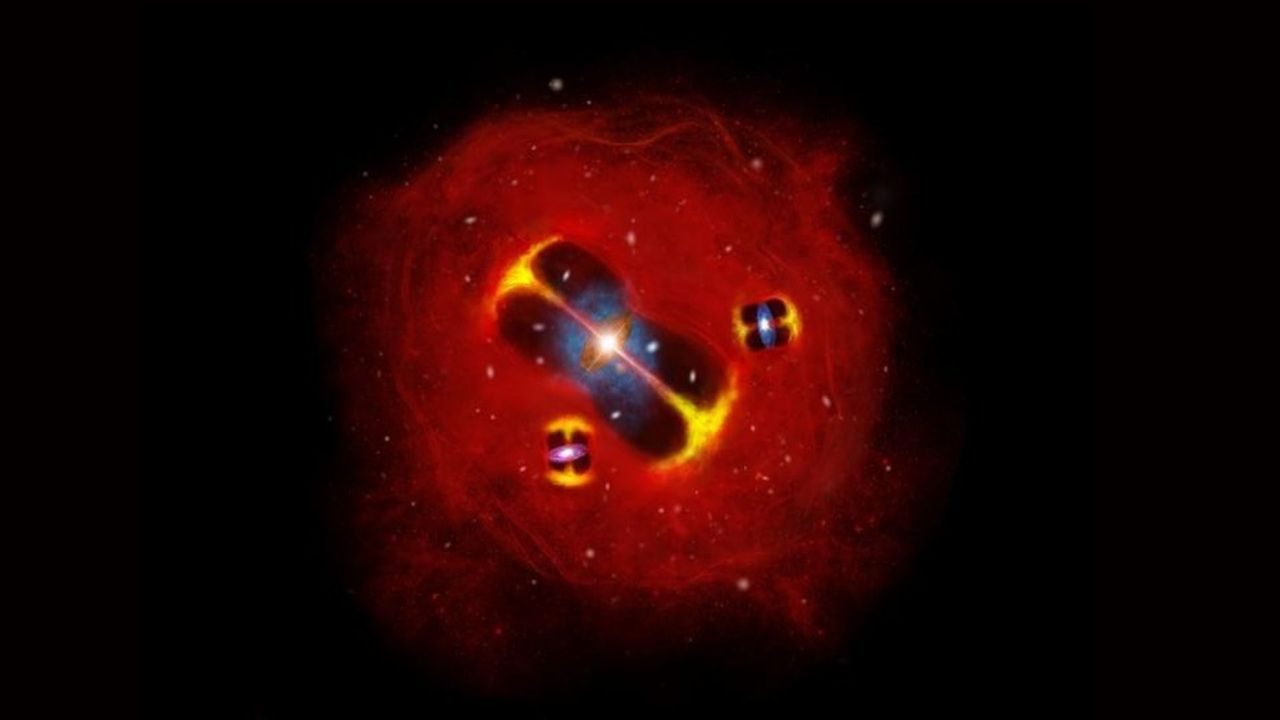
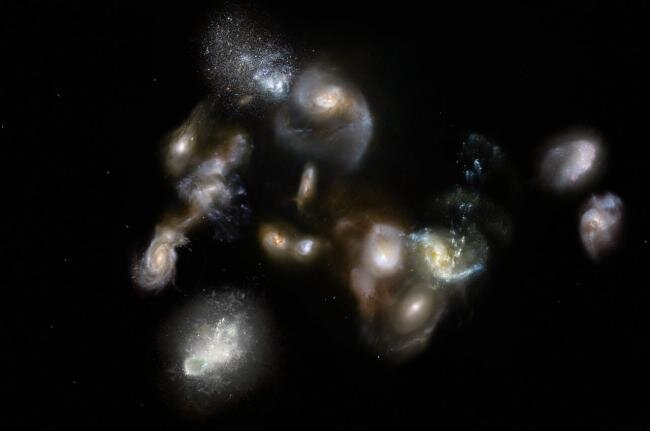
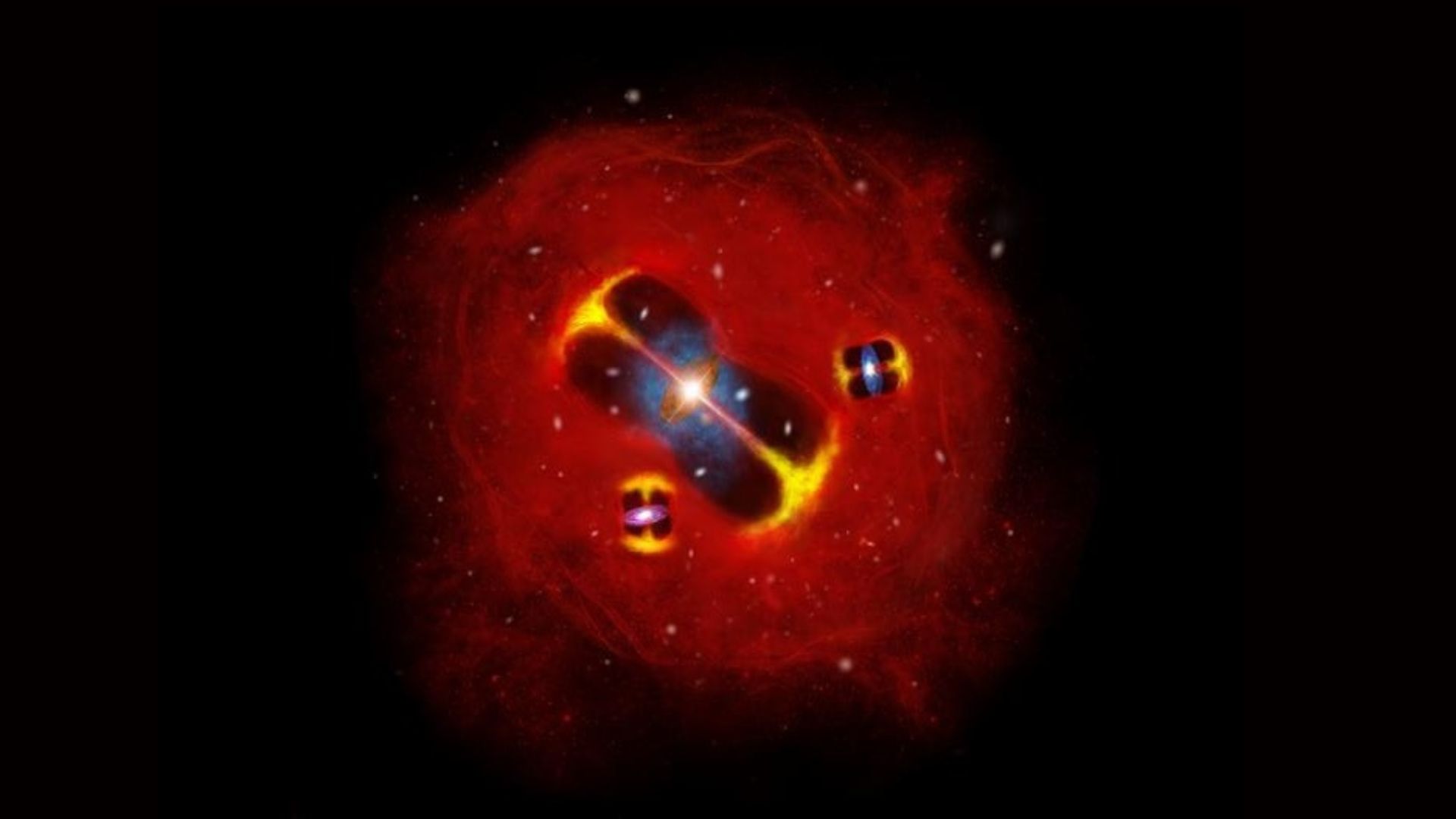 The gas streaming through an ancient galaxy cluster is five times hotter than theory predicts, yet again challenging our understanding of how objects evolved in the early universe.
(Image credit: Lingxiao Yuan)
Share
Share by:
The gas streaming through an ancient galaxy cluster is five times hotter than theory predicts, yet again challenging our understanding of how objects evolved in the early universe.
(Image credit: Lingxiao Yuan)
Share
Share by:
- Copy link
- X
Astronomers have spotted an unexpectedly hot galaxy cluster in the early universe that's challenging theories of galactic evolution.
The scorching cluster existed just 1.4 billion years after the Big Bang, blazing far earlier and hotter than current models of galaxy cluster formation predict should be possible. The discovery suggests that the predicted patterns of cluster growth might need a rethink, researchers reported Jan. 5 in the journal Nature.
You may like-
 Astronomers close in on signal from Epoch of Reionization
-
 James Webb telescope finds that galaxies in the early universe were much more chaotic than we thought
-
 'Not so exotic anymore': The James Webb telescope is unraveling the truth about the universe's first black holes
"Understanding galaxy clusters is the key to understanding the biggest galaxies in the universe," study co-author Scott Chapman, an astrophysicist at Dalhousie University who conducted the research while at the National Research Council of Canada (NRC), said in a statement. "These massive galaxies mostly reside in clusters, and their evolution is heavily shaped by the very strong environment of the clusters as they form, including the intracluster medium."
In the new study, researchers used the Atacama Large Millimeter/submillimeter Array (ALMA), a powerful radio telescope located in Chile, to observe a bright, young galaxy cluster known as SPT2349-56, whose light was emitted just 1.4 billion years after the Big Bang. This cluster is relatively small — about the size of the Milky Way's outer halo — but it contains more than 30 active galaxies and three supermassive black holes, and it forms stars more than 5,000 times as fast as the Milky Way.
Using a phenomenon called the thermal Sunyaev-Zeldovich effect, the team found that the gas in the intracluster medium is at least five times hotter than current theories of cluster formation predict it should be for its relatively young age.
"We didn't expect to see such a hot cluster atmosphere so early in cosmic history," study coauthor Dazhi Zhou, a PhD student in the department of physics and astronomy at the University of British Columbia, said in the statement. "In fact, at first I was skeptical about the signal as it was too strong to be real."
Sign up for the Live Science daily newsletter nowContact me with news and offers from other Future brandsReceive email from us on behalf of our trusted partners or sponsorsBy submitting your information you agree to the Terms & Conditions and Privacy Policy and are aged 16 or over.But it was real — and that could mean that galaxy clusters can form more quickly than expected.
related stories—Astronomers discover 'Quipu', the single largest structure in the known universe
—Did astronomers just discover the smallest galaxy in the universe?
—Astronomers discover giant 'bridge' in space that could finally solve a violent galactic mystery
"This tells us that something in the early universe, likely three recently discovered supermassive black holes in the cluster, were already pumping huge amounts of energy into the surroundings and shaping the young cluster, much earlier and more strongly than we thought," Chapman said.
In future studies, the team plans to investigate what this unusual cluster might mean for the formation and evolution of existing galaxy clusters.
"We want to figure out how the intense star formation, the active black holes and this overheated atmosphere interact, and what it tells us about how present galaxy clusters were built," Zhou said. "How can all of this be happening at once in such a young, compact system?"
 Skyler WareSocial Links NavigationLive Science Contributor
Skyler Ware is a freelance science journalist covering chemistry, biology, paleontology and Earth science. She was a 2023 AAAS Mass Media Science and Engineering Fellow at Science News. Her work has also appeared in Science News Explores, ZME Science and Chembites, among others. Skyler has a Ph.D. in chemistry from Caltech.
Show More CommentsYou must confirm your public display name before commenting
Please logout and then login again, you will then be prompted to enter your display name.
Logout Read more Astronomers close in on signal from Epoch of Reionization
 James Webb telescope finds that galaxies in the early universe were much more chaotic than we thought
 'Not so exotic anymore': The James Webb telescope is unraveling the truth about the universe's first black holes
 'Puzzling' object discovered by James Webb telescope may be the earliest known galaxy in the universe
 Rarrr! James Webb telescope spots 'monster stars' leaking nitrogen in the early universe
 'Colder and deader from now on': Euclid telescope confirms the universe has already peaked in star formation
Latest in Cosmology
'Colder and deader from now on': Euclid telescope confirms the universe has already peaked in star formation
Latest in Cosmology
 30 models of the universe proved wrong by final data from groundbreaking telescope
 James Webb telescope may have found the first stars in the universe, new study claims
'Puzzling' object discovered by James Webb telescope may be the earliest known galaxy in the universe
James Webb telescope may have found the first stars in the universe, new study claims
'Puzzling' object discovered by James Webb telescope may be the earliest known galaxy in the universe
 Record-breaking 'dark object' found hiding within a warped 'Einstein ring' 10 billion light-years away
 James Webb telescope could have spotted controversial 'dark stars' in the far universe
 The universe's first magnetic fields were 'comparable' to the human brain — and still linger within the 'cosmic web'
Latest in News
The universe's first magnetic fields were 'comparable' to the human brain — and still linger within the 'cosmic web'
Latest in News
 New US food pyramid recommends very high protein diet, beef tallow as healthy fat option, and full-fat dairy
 Rare 2,000-year-old war trumpet, possibly linked to Celtic queen Boudica, discovered in England
 Leonardo da Vinci's DNA may be embedded in his art — and scientists think they've managed to extract some
 NASA telescope combines 100 maps of the universe into one, promising huge discoveries
 9,500-year-old cremation pyre of a hunter-gatherer woman is the oldest of its kind in the world
 One of the last Siberian shamans was an 18th-century woman whose parents were related, DNA study reveals
LATEST ARTICLES
One of the last Siberian shamans was an 18th-century woman whose parents were related, DNA study reveals
LATEST ARTICLES- 1New US food pyramid recommends very high protein diet, beef tallow as healthy fat option, and full-fat dairy
- 2Rare 2,000-year-old war trumpet, possibly linked to Celtic queen Boudica, discovered in England
- 360,000-year-old poison arrows from South Africa are the oldest poison weapons ever discovered
- 4Leonardo da Vinci's DNA may be embedded in his art — and scientists think they've managed to extract some
- 5NASA telescope combines 100 maps of the universe into one, promising huge discoveries